

Figuring out a settlement value for post-concussion syndrome is never a simple formula. While claims can range from tens of thousands to over a million dollars, the final amount really comes down to the severity of your symptoms, the strength of your medical evidence, and the long-term impact on your daily life and your ability to work. This overview is for general information only and is not a substitute for legal advice tailored to your situation.
What Is a Typical Post Concussion Syndrome Settlement

When you are struggling with the lingering, often invisible symptoms of post-concussion syndrome (PCS), one of the most urgent questions is: What is my case actually worth? Unlike a dented car fender with a clear repair bill, putting a dollar figure on a brain injury is far more complex. There is no single “average settlement” that fits every situation.
Instead, the value of your claim is built piece by piece, looking at how this injury has touched every corner of your life. Your settlement is a reflection of both the bills you can stack up and the suffering you cannot.
Understanding the Settlement Ranges
Published case results and jury verdict reports show just how wide the outcomes can be. While some general sources might mention an average concussion settlement of around $65,000, that number does not even begin to tell the whole story. These figures often smooth over the vast differences between individual cases.
For instance, cases that are considered “mild,” where symptoms clear up in a few months, might resolve in the $20,000 to $80,000 range. But for severe PCS with chronic, debilitating symptoms that derail your career and destroy your quality of life, settlements can climb past $100,000 and sometimes reach into the millions. Past results do not guarantee future outcomes, and every case is different.
The key takeaway is that your case is unique. A settlement is not based on some national average; it is based on the specific, documented damages you have suffered.
To give you a clearer picture, here are illustrative examples by case severity. These are not guarantees, but they show how different factors can shape potential valuations.
Illustrative Post Concussion Syndrome Settlement Ranges
| Case Severity | Common Symptoms | Illustrative Settlement Range |
| Mild | Headaches, dizziness, and mild cognitive fog that resolve within 3-6 months with minimal disruption to work. | $20,000 – $85,000 |
| Moderate | Persistent headaches, significant memory/concentration issues, and mood changes lasting 6-18 months. | $85,000 – $250,000 |
| Severe | Chronic, disabling symptoms like debilitating migraines, severe cognitive impairment, personality changes, and loss of earning capacity. | $250,000 – $1,000,000+ |
As you can see, the impact on your life is what truly drives the value. A case involving a permanent inability to work will always be valued much higher than one with temporary symptoms.
Core Factors That Drive Your Claim’s Value
Insurance companies and attorneys look at several core elements to build a case’s value. Think of them as the building blocks of your settlement claim:
- Medical Expenses: This is more than just your initial ER visit. It includes every bill for diagnosis, ongoing treatment, physical and cognitive therapy, prescriptions, and any medical care you are projected to need in the future.
- Lost Income and Earning Capacity: This covers the paychecks you have already missed. More importantly, it covers the money you will not be able to earn in the future because of cognitive limits, physical restrictions, or the inability to return to your previous career.
- Pain and Suffering: This is the human cost. It’s compensation for the physical pain, the emotional distress, the anxiety, the depression, and the loss of enjoyment of life that the injury has forced upon you.
These three pillars form the foundation of your settlement demand. The stronger and more detailed the proof you have for each category, the more leverage you have in negotiations. Understanding how these damages are calculated is a critical step in any personal injury lawsuit. For more on this, check out our guide on personal injury lawsuit settlements and how much you could get.
Translating Your Symptoms Into a Stronger Claim
To get a fair post-concussion syndrome settlement, we have to translate your daily struggles into a powerful legal argument. Insurance companies love to call concussions “mild” injuries that should heal quickly. But when the symptoms do not go away, you are left with post-concussion syndrome (PCS). It is anything but mild.
From a legal standpoint, PCS is about connecting your persistent symptoms to the real-world impact on your life. This is not just a lingering headache; it’s a chronic condition that can dismantle your ability to work, engage with your family, and enjoy your life. Each symptom tells a part of your story and adds value to your claim.
The Three Faces of PCS Symptoms
PCS almost always shows up as a frustrating mix of physical, cognitive, and emotional symptoms. Understanding how these problems overlap is the first step to proving the true extent of your damages.
- Physical Symptoms: These are often the most obvious signs. You might be dealing with chronic headaches or migraines, constant dizziness, and an overwhelming sensitivity to light and sound. Many people with PCS also fight a deep fatigue that rest just does not fix.
- Cognitive Symptoms: This is the debilitating “brain fog” that makes everyday life so hard. Sufferers often report major issues with short-term memory, an inability to concentrate, and feeling like their brain is working in slow motion. These cognitive problems can make it impossible to return to your job or even manage simple household tasks.
- Emotional and Mood-Related Symptoms: The invisible wounds of PCS are frequently the toughest to endure. It is very common to feel a spike in irritability, anxiety, or depression. Many also experience personality changes or mood swings that can put a serious strain on their relationships with loved ones.
The Centers for Disease Control and Prevention (CDC) groups concussion symptoms into these same distinct but overlapping categories.
This shows that a brain injury is never just one thing. It’s a complex condition that impacts how you think, how you feel physically, and your emotional state. If you have any of these symptoms after an accident, seek medical care immediately. Only a qualified healthcare provider can diagnose your injury, and every single one of these symptoms must be documented to build a case that can withstand the insurance company’s scrutiny.
Building Your Claim from the Ground Up
The foundation of a strong PCS settlement is showing exactly how these symptoms have caused real, tangible losses. A daily headache is not just an annoyance; it is a condition that could stop you from looking at a computer screen, forcing you out of a job. Memory loss is not just a minor inconvenience; it is a cognitive impairment that might make it unsafe for you to care for your own children.
Our job as your legal team is to gather the proof that connects each symptom to a specific loss, whether it’s lost income, the cost of future medical treatments, or the profound damage to your quality of life. For a deeper look into this type of injury, you can learn more about how head injury lawyers help you recover compensation in our related article. By meticulously documenting the full spectrum of your suffering, we fight back against the insurance company’s attempts to downplay your injury and work to secure the compensation you deserve.
How Your Settlement Value Is Actually Calculated
Putting a number on a post-concussion syndrome case is not about using a simple calculator. It’s about building a case that tells the complete story of your losses, backed by solid proof. Insurance companies train their adjusters to pay out as little as possible. Our goal is to document every single dollar the injury has cost you and every part of your life it has taken away.
Your settlement is made up of two main types of damages: economic and non-economic. Think of it as accounting for both the bills you can hold in your hand and the invisible suffering that does not come with an invoice.
Economic Damages: The Tangible Costs
Economic damages are the most straightforward part of your claim. They represent the direct financial losses you have suffered because of the accident. We work to account for every penny this injury has cost you and will continue to cost you.
These damages typically include:
- Past and Future Medical Bills: This covers everything. The first trip to the ER, followed by MRI and CT scans, and ongoing visits with specialists such as neurologists, physical therapists, and counselors. We also consult with medical experts to forecast the costs of any future care you’ll need.
- Lost Wages: If your symptoms kept you from working, we calculate every dollar of income you lost. This is supported by documents such as pay stubs, work records, and tax returns.
- Loss of Future Earning Capacity: This can be one of the biggest factors in a serious PCS claim. If cognitive issues like brain fog or memory loss mean you cannot go back to your old job or get a promotion, we fight for compensation to cover the income you’ll lose over your working life.
Non-Economic Damages
Non-economic damages are meant to compensate you for the ways your injury has changed your life that do not have a clear price tag. These losses are harder to quantify, but no less real. In many cases, they make up the largest part of a settlement.
This category is for damages like:
- Pain and Suffering: This covers the physical pain from chronic headaches or dizziness and the emotional toll of the anxiety, frustration, and depression that often come with PCS.
- Loss of Enjoyment of Life: You deserve to be compensated if you can no longer participate in hobbies, spend time with family, or enjoy social activities the way you used to.
- Loss of Consortium: In some cases, your spouse may also have a claim for the loss of companionship and support they have experienced because of your injuries.
This infographic shows how the different symptoms of PCS are all connected, which forms the basis for proving these damages.
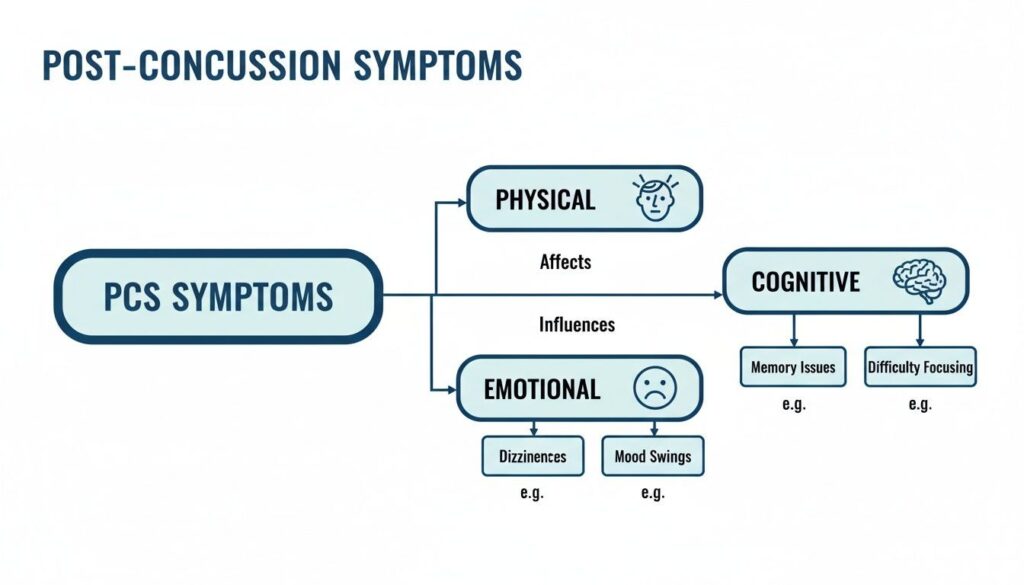
As you can see, the physical, cognitive, and emotional symptoms feed into one another, creating a ripple effect that damages nearly every part of a person’s life.
The Multiplier Method
So, how do you put a dollar value on something like suffering? One common tool attorneys use during negotiations is called the multiplier method. It is not a strict legal formula, but it gives us a starting point for valuing your non-economic damages.
The method involves taking your total economic damages, like medical bills and lost wages, and multiplying that number by a factor, usually between 1.5 and 5.
For example, if you have $50,000 in economic damages, we might argue for a multiplier of 4 because of the severity of your symptoms. That would place the value of your pain and suffering at $200,000, bringing the total initial settlement demand to $250,000.
The multiplier we push for depends entirely on the facts of your case, like how severe your symptoms are, how long they have lasted, and how much they have disrupted your life. It is not mandated by law, and insurers use different methods. For a deeper dive into this approach, see our article on how pain and suffering are calculated.
Ultimately, settlement amounts are driven by the severity and duration of your symptoms and how they impact your ability to work. Milder cases, where symptoms like headaches do not stop someone from working, might settle in the $20,000 to $80,000 range. But severe PCS cases with debilitating cognitive issues and chronic vision problems that make work impossible can result in awards over $1 million. As these are just examples of past outcomes from public sources, they do not guarantee or predict a similar result in any future case.
Proving the Long-Term Impact of Your Injury

When it comes to calculating a fair post-concussion syndrome settlement value, time is everything. Insurance companies know this, and they follow a playbook every time. They will frame your concussion as a short-term problem, pushing you to accept a lowball offer before anyone truly knows how long your symptoms will last.
Our founders know this playbook inside and out because they used to work for those same insurance companies. They understand that a standard concussion is not the same as persistent post-concussion syndrome (PCS). We use that inside knowledge to fight their arguments and prove your injury is a long-term condition that deserves serious compensation.
From Acute Concussion to Chronic PCS
A typical concussion might clear up in a few weeks. But when the headaches, memory fog, and fatigue drag on for months, or even years, it’s no longer just a concussion. It’s post-concussion syndrome. That distinction is the most important part of your claim.
PCS is not just a lingering headache; it’s a chronic neurological condition. An insurer will jump at the chance to argue that your ongoing memory problems or exhaustion must be from something else, not the accident. It’s a deliberate tactic they use to devalue your entire case.
The longer your symptoms persist and are documented by medical professionals, the stronger your case becomes. A detailed medical timeline is your most powerful weapon against an insurance company’s attempts to minimize your suffering.
Every doctor’s visit, every therapy session, and every prescription creates an undeniable record of your long-term battle. It proves that what you’re going through is not a minor inconvenience but a life-altering condition. To see just how serious these effects can be, you can explore the long-term effects of a traumatic brain injury in our detailed guide.
How Recovery Timelines Increase Settlement Value
The length of your recovery directly impacts your settlement value. A claim for symptoms that last three months is worlds away from a claim where symptoms have lasted over a year with no end in sight. The math is simple: more time lost means a higher value.
Real-world case results, though not guarantees of future outcomes, prove this time and again. One reported case involved a driver who developed PCS after being broadsided. The insurer’s initial offer was reportedly $31,000. But after proving the injury’s lasting complications, the case settled for $100,000.
When recovery is even longer, and impairments are permanent, the numbers can get much higher. A worker who fell and developed chronic post-concussion syndrome with severe vision and balance problems reportedly settled his case for $2.5 million. These examples highlight a core truth: the more time and quality of life your injury steals from you, the more compensation you may be able to recover.
Countering Common Insurance Company Tactics
Insurance adjusters are trained to poke holes in your story. They will hunt for any gap in your medical treatment or any post on social media to argue your condition is not as bad as you say.
Be ready for these common tactics:
- Pointing out “gaps in treatment”: If you miss appointments or wait to see a specialist, they will claim your injuries were not that serious to begin with.
- Scouring your social media: They will look for any photo or comment that seems to contradict your claims of pain and limitation.
- Using “independent” medical exams (IMEs): Insurers send you to their own hand-picked doctors, who often write reports that conveniently downplay the severity of your symptoms.
Our experienced attorneys know these strategies are coming. We help you build a fortress of evidence around your claim, leaving no room for doubt. By documenting every symptom in a journal, keeping every appointment, and showing how your life has changed, we build a case so strong that we can fight for its full value.
Gathering the Evidence Needed to Maximize Your Claim
A strong post-concussion syndrome settlement value is not based on what you say happened; it is based on what you can prove. To recover the compensation you deserve, you need to build a solid foundation of evidence that shows the insurance company exactly what this injury has cost you.
Think of it as building your case, one piece at a time. Every record, every receipt, and every note is another block in that foundation. The stronger your evidence, the harder it is for an insurer to deny, delay, or underpay your claim.
The Power of Medical Documentation
Your medical records are the absolute bedrock of your case. Insurers are experts at downplaying injuries they can’t see, and consistent, detailed medical documentation is the single most effective way to fight back. Without it, your claim is on shaky ground.
Your file needs to include all documents related to your diagnosis and treatment. Make sure you have:
- Diagnostic Imaging: Any reports from MRI, CT scans, or other imaging tests that were ordered.
- Specialist Reports: The detailed notes from every specialist you have seen, including neurologists, neuropsychologists, and physical therapists.
- Treatment Records: A complete history of every doctor’s visit, therapy session, and emergency room trip.
- Prescription History: A list of all medications prescribed to manage your symptoms, whether for pain, anxiety, or insomnia.
Evidence Beyond the Doctor’s Office
While medical records are critical, they only tell part of the story. Post-concussion syndrome spills into every corner of your life, and you need evidence that proves it. This non-medical proof is often what shows the true, human cost of your injury.
Your personal story is one of the most powerful parts of your claim. Documenting how your life has changed, in your own words, provides authentic and compelling evidence of your suffering that a simple medical bill never could.
Here’s what you need to collect to show the full picture of your losses:
- A Personal Symptom Journal: This is one of the most powerful tools you have. Every day, write down your pain levels, cognitive struggles, mood, and any specific activities your symptoms prevented you from doing. Be specific.
- Employment Records: Gather pay stubs, performance reviews, and any emails or letters from your employer that show missed work, a demotion, or a documented drop in performance.
- Witness Statements: Ask the people who know you best, family, friends, and coworkers, to write down the changes they have seen in you since the accident. These third-party accounts are incredibly valuable because they validate your own reports.
By meticulously gathering both medical and personal evidence, you create a comprehensive file that leaves no doubt about the severity of your condition. For more tips on building your case, read our guide on how to document your personal injury case from start to finish. This systematic approach is essential for forcing the insurance company to take your claim seriously and pay you the full compensation you are owed.
Why An Experienced Attorney Is Your Best Ally
Trying to handle a post-concussion syndrome claim on your own is more than just difficult; it’s a setup for disappointment, especially when you are also trying to recover from an invisible brain injury. Insurance companies have a well-rehearsed playbook for these claims. They are experts at downplaying symptoms, questioning the severity of your condition, and making lowball offers before you even know the full extent of your damages.
Fighting them on your own is like entering a professional fight with one hand tied behind your back. You are outmatched from the start. An experienced personal injury attorney does not just level the playing field; they become your shield and your advocate, protecting you from the insurance industry’s tactics.
Knowing the Insurance Company’s Playbook
Because the founders of Pacin Levine, P.A., once worked for insurance companies, we have firsthand knowledge of how adjusters are trained to minimize payouts. They will argue that your persistent headaches or memory fog are unrelated to the accident, or that you should have recovered by now. They will scrutinize your every move, looking for any excuse to deny your claim.
This insider knowledge is your strategic advantage. We know how to anticipate their arguments, counter their delay tactics, and build a case so strong that they have to take you and your injury seriously.
Having a legal ally in your corner can make a profound difference. Here’s a look at what you are up against when you go it alone compared to having an experienced firm by your side.
Handling a PCS Claim Alone vs With an Attorney
| Claim Aspect | Handling It Alone | With An Experienced Attorney |
| Evidence Gathering | You are responsible for chasing down every medical record, report, and piece of evidence needed to prove your case. | Your legal team handles all document requests, hires necessary experts, and gathers witness statements on your behalf. |
| Calculating Damages | You might only count the obvious bills, completely missing the true value of future care, lost earning capacity, and suffering. | We calculate every single economic loss and use proven methods to put a fair value on the non-economic impact on your life. |
| Negotiation | You’re up against a trained insurance adjuster whose entire job is to pressure you into accepting the lowest possible offer. | We conduct aggressive, evidence-based negotiations, fighting for the maximum settlement value for post-concussion syndrome. |
| Litigation | If the insurer refuses to be fair, your only option is to accept their low offer or give up on your claim entirely. | We are always prepared to take your case to court and present your story powerfully to a judge and jury. |
| Managing Stress | You’re left to juggle doctor appointments, confusing claim paperwork, and constant calls from the insurer, all while trying to heal. | You can focus completely on your recovery while we handle every legal detail and communication for you. |
As you can see, the right legal partner does not just help with paperwork; they take the entire burden off your shoulders so you can focus on what truly matters: getting better.
Maximizing Your Compensation
Hiring an attorney is not just about convenience; it is about results. Some studies have found that represented claimants receive significantly higher payouts on average than those without lawyers.
An attorney’s role is far more than just filing paperwork. We work to:
- Hire Medical Experts: We connect you with top neurologists, neuropsychologists, and other specialists who can provide the expert testimony needed to validate your long-term symptoms and future needs.
- Calculate Your True Losses: We meticulously document your lost wages, diminished earning capacity, and future medical costs to ensure no dollar of damage is overlooked.
- Fight for Full Value: We use our experience to build an aggressive claim strategy and negotiate from a position of strength, pushing for the full and fair compensation you deserve.
While past results cannot guarantee future outcomes, our experience is your advantage. Our goal is to secure the best possible result for your unique case and circumstances.
Common Questions About Post-Concussion Syndrome Settlements
When you’re trying to recover from an accident, the legal process can feel overwhelming. You’re bound to have urgent questions. Below, we’ve answered some of the most common concerns we hear from clients who are dealing with the fallout of post-concussion syndrome.
How Long Do I Have to File a Lawsuit?
Every state has a strict deadline for filing a personal injury lawsuit, known as the statute of limitations. This is one of the most important rules in your case, and it varies by state. For example, as of early 2024, the general negligence statute of limitations is 2 years in Illinois, 3 years in Wisconsin, and 2 years in Indiana. These deadlines can have exceptions and are subject to change.
The tricky part with PCS is that symptoms often show up late. But the legal clock almost always starts ticking on the day of the accident, not the day you finally feel the cognitive fog or chronic headaches. If you wait too long, you can lose your right to recover any compensation forever. To understand how these rules apply to your case, speak with an experienced personal injury attorney quickly.
Can I Still File a Claim if My Symptoms Showed Up Weeks Later?
Yes, you absolutely can. It’s incredibly common for the full impact of a head injury, like persistent headaches, brain fog, and mood swings, to take weeks or even months to surface. This delayed onset is a known hallmark of post-concussion syndrome.
However, insurance companies love to use this delay against you. They will argue that because your symptoms were not immediate, they must be unrelated to the accident. This is precisely why getting checked by a doctor right away and consistently documenting your symptoms is non-negotiable. It creates the paper trail needed to connect your condition directly back to the initial injury.
What if the Insurance Company Makes a Quick Offer?
Be very, very careful. An insurance adjuster’s job is not to help you; it’s to close your claim for as little money as possible. A fast settlement offer is a classic tactic. They hope to tempt you with quick cash before you understand the true, long-term costs of your injury.
Accepting an early offer almost always means leaving money on the table. Once you cash that check, you lose your right to seek any more money, even if your symptoms get much worse.
Never accept an offer from an insurance company without first talking to an experienced personal injury attorney. We can help you understand what your future needs might be and calculate a fair settlement value for post-concussion syndrome.
How Much Does It Cost to Hire a Lawyer?
At our firm, we help clients nationwide through local co-counsel and handle all personal injury cases on a contingency fee basis. This means you pay us absolutely nothing upfront. We cover every cost associated with building your case, from gathering records to hiring experts.
You only pay a legal fee if we win your case and recover money for you. That fee is just a percentage of the settlement or verdict we secure for you. If we don’t win, you do not owe us a dime. This approach removes all financial risk from the equation and gives you access to the expert legal help you need right now.
The aftermath of an accident is disorienting, but you do not have to navigate it by yourself. The attorneys at Pacin Levine, P.A. know the insurance industry’s playbook inside and out, and we are ready to fight for the full and fair compensation you are owed. Contact us today for a free, no-obligation consultation to discuss your case. https://pl-law.com.


