
When you see flashing lights in your rearview mirror, the last thing on your mind is the specific acronym an officer will write on a ticket. Still, the terms DWI (Driving While Intoxicated) and DUI (Driving Under the Influence) cause a lot of confusion.
The simple truth is that while the names change from state to state, both refer to the same serious crime: operating a vehicle while impaired by alcohol or drugs.
DWI vs DUI: What Is the Difference
At the end of the day, the biggest difference between DWI and DUI is just the label a particular state decides to use. There is no single, nationwide standard. The core of the offense is always the same: driving with your physical or mental abilities impaired, but what it is called on the charging documents depends entirely on local law.
It is easy to get caught up in the acronyms, but the legal consequences are serious, no matter what it’s called. Understanding these subtle differences is a key first step after an arrest, but it is important to grasp the core implications of any impaired driving charge.

How States Define DWI or DUI
This is where things get a bit more complex. States do not just pick a term at random; the label they use often reflects how their laws are structured. Some use the terms to distinguish what caused the impairment, while others use a single term to cover everything.
- Interchangeable Terms: In many states, DUI and DWI are used interchangeably. Whether you are impaired by alcohol or drugs, the charge is the same, and there is no real legal difference between the two acronyms.
- Specific Substance: Some jurisdictions get more specific. They might use DWI strictly for alcohol-related offenses and DUI for impairment caused by any other substance, including prescription medication or illegal drugs.
- Degree of Impairment: A handful of states use different terms to signal how intoxicated a driver was. For instance, a DWI might be a more serious charge for a very high blood alcohol concentration (BAC), while a DUI could be used for a lesser degree of impairment.
How Different States Label Charges
The lack of a uniform system across the U.S. means the name of the charge can change the moment you cross a state line. This patchwork of laws highlights why it is so critical to understand the specific rules where your arrest took place. For a closer look, you can read our guide on Pennsylvania’s DUI laws to see how one state handles these complex situations.
How States Label Impaired Driving Offenses
| State | Primary Terminology Used |
| Illinois | DUI (Driving Under the Influence) |
| Wisconsin | OWI (Operating While Intoxicated) |
| Indiana | OVWI (Operating a Vehicle While Intoxicated) |
| Texas | DWI (Driving While Intoxicated) |
| New York | DWI (Driving While Intoxicated) & DWAI (Driving While Ability Impaired) |
As you can see, the labels are all over the map. From Illinois’s straightforward DUI to New York’s two-tiered system of DWI and DWAI, it all comes down to local statutes. This is why a one-size-fits-all defense strategy simply does not work. This overview is for general information only and is not a substitute for legal advice tailored to your situation.
How Blood Alcohol Concentration Defines a DUI
While the names for drunk driving charges change from state to state, the evidence prosecutors use is almost always the same. In nearly every DUI or DWI case, it all comes down to one number: your Blood Alcohol Concentration, or BAC.
This is the scientific measurement that law enforcement uses to prove you were legally impaired. It represents the percentage of alcohol in your bloodstream. So, if your BAC is 0.08%, it means you have 80 milligrams of alcohol for every 100 milliliters of blood. That single number becomes the centerpiece of the state’s case against you.
The Legal Limits for BAC
Across the country, there is a general agreement on what constitutes legal impairment. While some details vary, the main thresholds are set for different driver types.
For most drivers over the age of 21, the legal limit is a 0.08% BAC. If a breathalyzer or blood test shows your BAC is at or over that line, you are considered “per se” intoxicated. This is a critical point. It means the prosecutor does not have to prove you were swerving or slurring your words; the number itself is enough evidence to charge you.
However, the rules get much tougher for certain drivers:
- Commercial Drivers: If you operate a commercial vehicle, such as a semi-truck, the federal standard drops to 0.04% BAC. A conviction at this level can cost you your commercial driver’s license (CDL) and, very likely, your career.
- Underage Drivers: Every state has “Zero Tolerance” laws for drivers under 21. This does not always mean a BAC of 0.00%. The limit is usually set at 0.01% or 0.02% to allow for things like mouthwash, but the message is clear: any detectable amount of alcohol can trigger a DUI and severe license penalties.
These strict laws exist for a reason. As of early 2024, data from the National Highway Traffic Safety Administration (NHTSA) shows that about 30% of all traffic fatalities in recent years involved a driver with a BAC over the legal limit. It is a staggering figure that highlights the public safety crisis these laws are meant to combat.
Factors That Influence Your BAC
One of the most dangerous myths is that you can count your drinks to know if you are safe to drive. The truth is, your BAC is deeply personal and depends on a whole range of factors. This is why you might feel perfectly fine but still be well over the legal limit. Even a small amount of alcohol can have a big impact, and it is always important to understand how alcohol impairs your driving skills and judgment.
Your BAC is not static. It continues to rise for a period after you stop drinking, hits a peak, and then slowly starts to fall. This timeline is a critical detail that an experienced attorney can use to challenge a test taken long after you were pulled over.
Here are the key variables that can affect your BAC:
- Body Weight and Composition: A smaller person will almost always have a higher BAC than a larger person after drinking the same amount.
- Gender: Because of differences in body water and enzymes, women often metabolize alcohol differently and can reach a higher BAC faster than men, even at the same weight.
- Metabolism: Everyone’s body processes alcohol at a unique rate.
- Food Consumption: Drinking on an empty stomach allows alcohol to absorb into your bloodstream much more quickly, causing a faster and higher BAC spike.
Because all these factors make it impossible to guess your own BAC accurately, the only safe choice is not to drive after drinking at all. The science is complicated, but for the prosecution, it is the foundation of their entire case.
Comparing Penalties for First and Repeat Offenses
A DWI or DUI charge is a serious wake-up call. But the consequences get dramatically worse with each new conviction. States draw a very clear line between a one-time mistake and a pattern of dangerous behavior, and that line makes all the difference in the courtroom. Understanding this is critical because the penalties do not just increase; they become life-altering.
A single conviction can disrupt your life, but a second or third can derail it completely. The legal system is designed to impose increasingly harsh punishments to deter repeat offenses and keep the public safe.
Penalties for a First Offense
For most people, a first-time DWI or DUI is a misdemeanor, as long as there were no aggravating factors like an accident or serious injury. While it’s still a very serious charge, the system’s goal is often more corrective than purely punitive.
Common penalties for a first-time offender often include:
- Fines and Court Costs: These can run from several hundred to a few thousand dollars.
- Jail Time: While possible, jail for a first offense is often short. In many cases, it might be suspended if you complete other court requirements.
- License Suspension: You should expect a mandatory suspension of your driving privileges, typically lasting from a few months to a year.
- DUI School or Education Programs: Courts almost always require you to complete state-approved alcohol and drug education courses.
These penalties are significant, but they are often designed to give you a chance to learn from a mistake without permanently shutting you out of society. Every case is different, and you should speak to an attorney to understand the specific risks you face.
The Harsh Reality of Repeat Offenses
When you are facing a second, third, or subsequent charge, the court’s approach changes completely. The penalties stop being corrective and become severely punitive.
A second or third offense often elevates the charge from a misdemeanor to a felony. This single change carries lifelong consequences, including the potential loss of civil rights such as voting or owning a firearm, and it can permanently damage your ability to find a job or housing.
Repeat offenders face a much steeper set of consequences:
- Mandatory Jail or Prison Time: Unlike a first offense, judges often have their hands tied. Many state laws impose mandatory minimum jail sentences or even long-term prison time.
- Felony Conviction: A repeat DUI is frequently treated as a felony, creating a permanent criminal record that follows you forever.
- Extended License Revocation: Your license will not be suspended alone. It will likely be revoked for multiple years or, in some states, permanently.
- Ignition Interlock Device (IID): Most states will require you to install an IID on your vehicle at your own expense. This device works like an in-car breathalyzer and will not let the engine start if it detects alcohol on your breath.
The reason for this escalation is clear. Nationally, alcohol-impaired driving consistently accounts for a significant portion of all traffic-related deaths, and law enforcement is laser-focused on repeat offenders.
Understanding State Lookback Periods
How far back does the state look to see if you are a “repeat” offender? The answer is in the state’s lookback period. This is the specific timeframe a court uses to count prior convictions against you for sentencing purposes.
For example, a state might have a 10-year lookback period. If you had a DUI nine years ago and get another one today, your new charge will be treated as a second offense. But if that prior DUI was 11 years ago, your new charge might be handled as a first offense again. States like Illinois and Indiana have their own specific lookback rules, and these laws can change. It is absolutely essential to speak with an attorney who understands the law under which you were charged.
Because the penalties for a DWI or DUI are so severe and escalate so quickly, fighting your first charge is absolutely critical. A conviction today sets you up for a felony charge tomorrow. An experienced attorney can analyze the evidence, challenge the prosecution’s case, and work to protect your future from the devastating impact of a repeat offense.
The Two Battles You Face: Criminal Charges And License Suspension
One of the most confusing things after a DWI or DUI arrest is realizing you are not just fighting one case, you are fighting two separate legal battles at the same time. The moment you are arrested, two parallel clocks start ticking. Each one comes with its own rules, its own deadlines, and its own devastating consequences.
Understanding this dual-track system is the first critical step toward protecting both your freedom and your driver’s license.
The first battle is the one everyone thinks of: the criminal case. This is what happens in a court of law. A prosecutor, representing the state, will try to prove you are guilty of a crime. If you are convicted, the penalties can be severe, including hefty fines, probation, mandatory alcohol education classes, and even jail time.
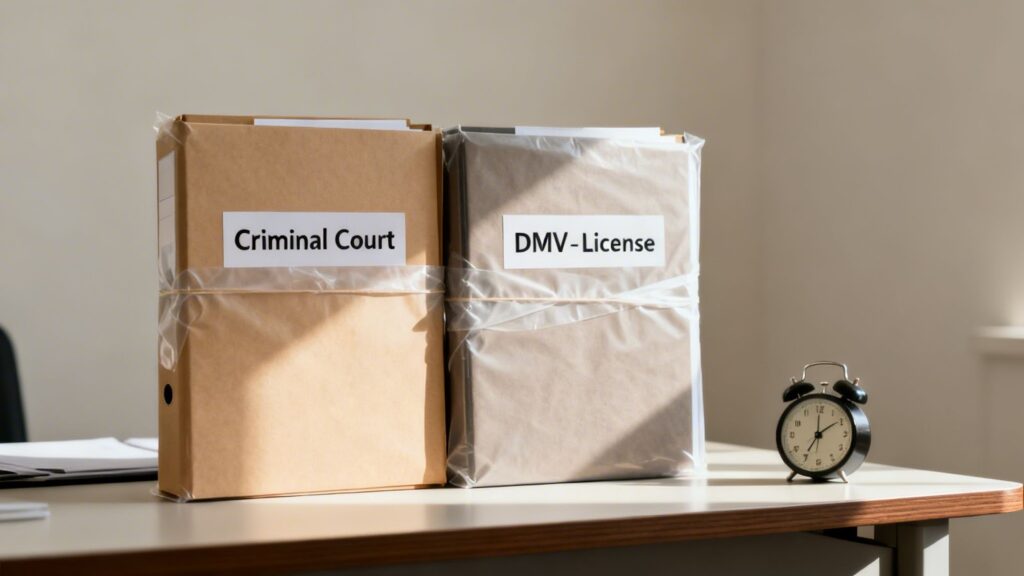
The second battle, however, is the administrative action with your state’s Department of Motor Vehicles (DMV). This process is completely separate from your criminal case and focuses solely on suspending or revoking your driving privileges. This action is triggered automatically by the arrest itself, usually because you either refused a chemical test or your test results were over the legal limit.
These two proceedings are independent. This is a point that far too many people miss, often with serious consequences.
You can be found not guilty in your criminal case and still have your license suspended by the DMV. On the flip side, winning your DMV hearing does not guarantee your criminal charges will be dismissed.
The reason they are separate is that they have different goals and, importantly, different standards of proof. The criminal court must prove your guilt “beyond a reasonable doubt,” a very high standard. The DMV, on the other hand, only needs to show it was more likely than not that the officer had grounds to arrest you and that you failed or refused a chemical test.
Criminal vs Administrative Actions After a DUI Arrest
| Aspect | Criminal Case (Court System) | Administrative Action (DMV) |
| Purpose | To determine guilt or innocence of a crime. | To determine eligibility for driving privileges. |
| Potential Penalties | Jail time, fines, probation, community service, mandatory classes. | License suspension or revocation, ignition interlock device requirements. |
| Standard of Proof | “Beyond a reasonable doubt” (high standard). | “Preponderance of the evidence” (lower standard). |
| Initiated By | The State/Prosecutor is filing formal charges. | The arresting officer filed a report with the DMV. |
| Key Deadline | Varies by state; follows criminal procedure rules. | Extremely short; often 10-30 days to request a hearing. |
As you can see, each track has its own agenda and its own timeline. Ignoring one to focus on the other is a recipe for disaster.
The Deadlines Are Incredibly Tight
The most dangerous part of this two-front battle is the administrative deadline. In many states, including Illinois and Indiana, you have an extremely short window, sometimes as little as 10 to 30 days from the date of your arrest, to formally request a hearing to challenge the automatic license suspension.
If you miss this deadline, you forfeit your right to fight. Your license will be suspended automatically, no questions asked.
This is why contacting an attorney immediately after a DWI or DUI arrest is not just a good idea; it is absolutely essential. An experienced lawyer can file the necessary paperwork to preserve your right to a DMV hearing while simultaneously starting to build a defense for your criminal case.
On top of everything else, your car may have been taken away after the arrest. For more on that, read our guide on what happens if your car is impounded by police. Failing to act quickly on both the criminal and administrative fronts can leave you without a license and at a major disadvantage in court.
Common Defense Strategies for DWI and DUI Charges
An arrest for a DWI or DUI is a terrifying moment, but it is just that: an arrest, not a conviction. The prosecutor has the entire burden of proving their case against you beyond a reasonable doubt. A skilled attorney knows exactly where to look for the weaknesses in their arguments.
There are many chances to challenge the evidence and fight for a much better outcome. That could mean a full dismissal, a reduction in charges, or an acquittal if your case goes to trial. A strong defense starts with a simple but critical idea: it is not just about what happened, but whether the police followed every single legal rule along the way.
Challenging the Traffic Stop and Arrest
The entire foundation of a DWI or DUI case rests on the initial traffic stop. The Fourth Amendment protects you from unreasonable searches and seizures, which means an officer cannot just pull you over on a whim. They must have reasonable suspicion that you broke a traffic law or were involved in some kind of criminal activity.
If the officer cannot point to a specific, valid reason for the stop, like speeding, swerving, or even a simple broken taillight, the stop itself might be illegal. An unlawful stop can lead to a powerful legal consequence: all evidence gathered afterward, including field sobriety tests and breathalyzer results, can be thrown out of court. This often dismantles the prosecution’s entire case. You can see more about how video evidence plays a part by learning how dash cam footage can help your case.
Scrutinizing Test and Evidence Procedures
Even if the traffic stop was perfectly legal, the evidence the police collect has to be reliable and handled correctly. This is where a defense attorney often finds the most critical mistakes.
- Field Sobriety Tests (FSTs): These tests, such as the walk-and-turn or one-leg stand, are notoriously subjective. They can be tough for anyone to perform perfectly, even when completely sober. An attorney can challenge the results by showing that the officer gave the instructions incorrectly, failed to consider your medical conditions, or made you perform them on an unsafe, uneven surface.
- Breathalyzers and Chemical Tests: Breathalyzers are not foolproof. They require very precise calibration and consistent maintenance to work properly. An experienced lawyer will demand the machine’s maintenance logs to check for a history of errors or to see if it was not certified correctly. Any mistake can make the BAC results inadmissible in court.
- Chain of Custody: In blood or urine tests, the prosecution must prove an unbroken chain of custody. This means they need to document every person who handled the sample, from the moment it was collected until it was tested. Any gap or procedural error in this chain could mean the evidence was contaminated and is no longer reliable.
This flowchart shows some of the most common angles a defense attorney will investigate in a DWI or DUI case.
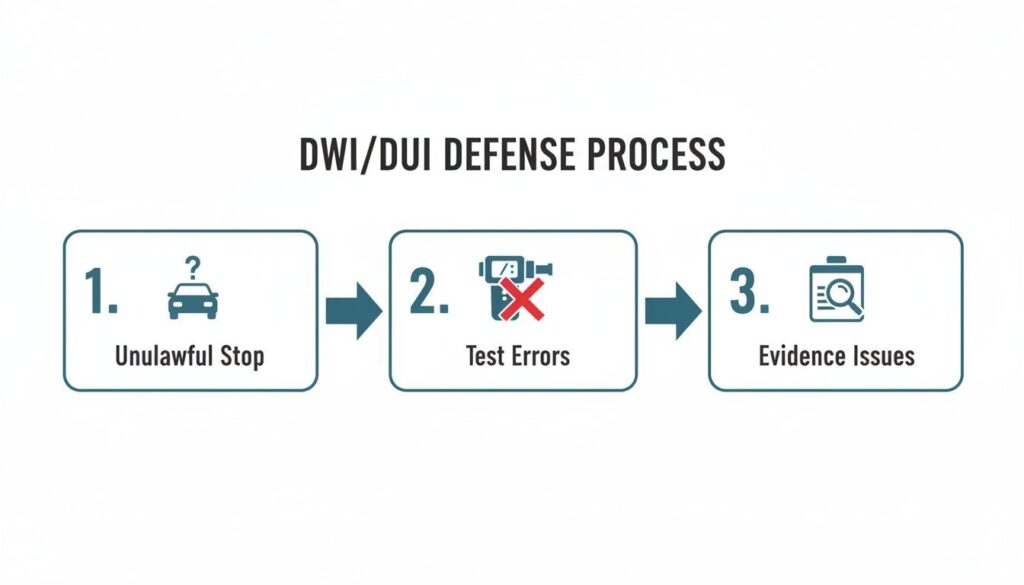
As you can see, a strong defense is built by questioning the legality of the stop, the accuracy of the tests, and the integrity of the evidence itself.
Presenting Alternative Explanations
Sometimes, the “obvious” signs of intoxication that an officer observes have a perfectly innocent explanation. A good defense involves presenting these alternative theories to the court to create reasonable doubt.
An officer’s observations are just that: observations. They are not scientific facts. A skilled attorney can challenge the officer’s interpretation of your behavior and present other plausible reasons for what they saw.
For example, certain medical conditions can look a lot like impairment. Diabetes can cause a person’s breath to have a fruity odor that officers easily mistake for alcohol. In the same way, old physical injuries, certain neurological issues, or even just being exhausted can seriously affect your balance and coordination, leading to a poor performance on field sobriety tests.
An attorney can bring these facts to the court’s attention with medical records and expert testimony. By doing so, they can show that the “signs” of impairment had nothing to do with alcohol or drugs. Presenting these defenses shows the prosecution’s case is not nearly as solid as it seems, creating an opportunity to negotiate a better outcome or argue for a not-guilty verdict at trial.
What to Do Immediately After a DUI Arrest
The moments after a DUI or DWI arrest are a blur of chaos and fear. We have seen it countless times with clients. Your head is spinning, and it feels like everything is on the line. What you do next can truly shape the rest of your life.
Your first, most important move is to use your constitutional right to remain silent. It is not just something you see in movies. Police officers are trained to ask questions designed to get you to admit guilt. You need to politely but firmly tell them you will not answer any questions until your attorney is present. Anything you say, no matter how harmless it seems, can be used against you.
Take These Critical First Steps
Once you have made it clear that you are not speaking without a lawyer, the next priority is to get one. The legal system moves at lightning speed, and crucial deadlines for your case can fly by in just a few days. A qualified defense attorney can step in immediately to protect your rights.
Here is a practical checklist of what you need to do:
- Contact a DUI Defense Attorney Immediately: This cannot wait. An experienced lawyer can intervene early, take over communications with law enforcement, and start building your defense from day one.
- Request an Administrative License Hearing: In many states, you have a very short window, sometimes only a matter of days, to challenge the automatic suspension of your driver’s license. An attorney can file this request for you, which is critical for preserving your right to drive while the criminal case is pending.
- Document Every Detail: As soon as you possibly can, write down everything you remember. Where were you coming from? What did you eat and drink, and when? Why did the officer pull you over? What did they say, and how did they conduct the field sobriety tests? Memories fade fast, and these small details can become game-changing evidence.
Preserve Evidence and Identify Witnesses
Your next job is to help your attorney gather the evidence needed to fight the charges. Do not make the mistake of thinking the police report tells the whole story. It does not. It is the prosecutor’s version of events, not yours.
In the immediate aftermath of a DUI arrest, you are your own best investigator. Preserving evidence before it vanishes can be the difference between a conviction and a dismissal.
While your attorney will handle the formal legal work, you can give them a powerful head start by taking these steps:
- Identifying Witnesses: Was anyone with you before you drove? Did anyone see the traffic stop unfold? Get their names and phone numbers.
- Saving Receipts: Any receipts from restaurants, bars, or stores can help build a clear timeline of your evening.
- Checking for Cameras: Look for nearby businesses or homes that might have security cameras pointed toward the traffic stop. This footage could directly contradict the officer’s report.
The stakes are incredibly high, which is why law enforcement takes these charges so seriously. Reputable sources like the National Safety Council often report a tragic spike in drunk driving fatalities during holiday periods. Analysis over the last decade has revealed an alarming rise in alcohol-impaired fatalities, underscoring the dangers on the road that drive this strict enforcement.
If you were the one injured by a drunk driver, the legal path is different but just as urgent. You can learn how to prove fault when injured in a DUI accident in our detailed guide. Taking these proactive steps right after an arrest is the single best way to protect your rights and build the strongest possible defense.
Frequently Asked Questions About DUI and DWI
When you are facing a DUI or DWI charge, the questions can pile up fast. It is a confusing and stressful time, and it is completely normal to feel overwhelmed about what comes next. Here are some straightforward answers to the ones that come up most often. This information is for general educational purposes and is not a substitute for speaking with an attorney about your specific case.
Can I Refuse a Breathalyzer or Chemical Test?
You can refuse a breathalyzer or other chemical test, but that decision comes with immediate and serious consequences. Every state has “implied consent” laws. What this means is that by getting a driver’s license, you have already legally agreed to take a chemical test if you are lawfully arrested for a DUI or DWI.
Saying no to the test will almost always trigger an automatic and lengthy suspension of your driver’s license. In many cases, this administrative suspension is even longer than what you would face for a first-time conviction. If you have a prior refusal, doing it again could even lead to a separate criminal charge in some states.
Will a DWI or DUI Charge Affect My Job?
Yes, a conviction can have a major impact on your employment. For some people, it can be career-ending.
- Commercial Drivers: If you drive for a living, whether it’s a truck, bus, or delivery vehicle, a conviction or even just a license suspension will likely get you fired.
- Licensed Professionals: People like nurses, pilots, doctors, and lawyers may have to report a conviction to their state licensing board. That can trigger disciplinary action that puts their professional license at risk.
- General Employment: Even if driving is not part of your job, a criminal conviction will show up on background checks. This can make it much harder to find a new job or even get approved for housing.
Fighting the charge from the very beginning is the best way to protect your livelihood from the long-term damage a conviction can leave behind.
This information is for general educational purposes only and is not a substitute for legal advice. Laws vary by state, and you should consult with an attorney to understand how the law applies to your specific situation.
How Long Does a DUI Stay on Your Record?
In most states, a DUI conviction is a permanent part of your criminal record. While minor traffic tickets might eventually disappear, a DUI or DWI is a serious criminal offense. It often stays visible on background checks for employment, housing, and loans for the rest of your life.
Many states specifically block DUI convictions from being expunged or sealed. That means the mistake follows you forever. An experienced attorney knows the stakes are high and will fight to avoid a conviction in the first place, often by working to get the case dismissed or negotiating for a reduction to a lesser charge with less severe and permanent consequences.
The legal system moves fast, and the stakes are too high to face a DWI or DUI charge alone. The team at Pacin Levine, P.A. understands what’s on the line and is ready to fight for you. Our firm helps personal injury victims across multiple states by leveraging a nationwide network of co-counsel to stand up for our clients. Available 24/7 in English and Spanish, we offer a free and confidential consultation to discuss your case. Contact us today to learn how we can work to protect your rights and your future. Visit us at https://pl-law.com.